Business Applications
An organization can’t function well without its fundamental business applications. These applications must be readily accessible, execute quickly, and provide enterprises with the assurance that they will perform as expected.
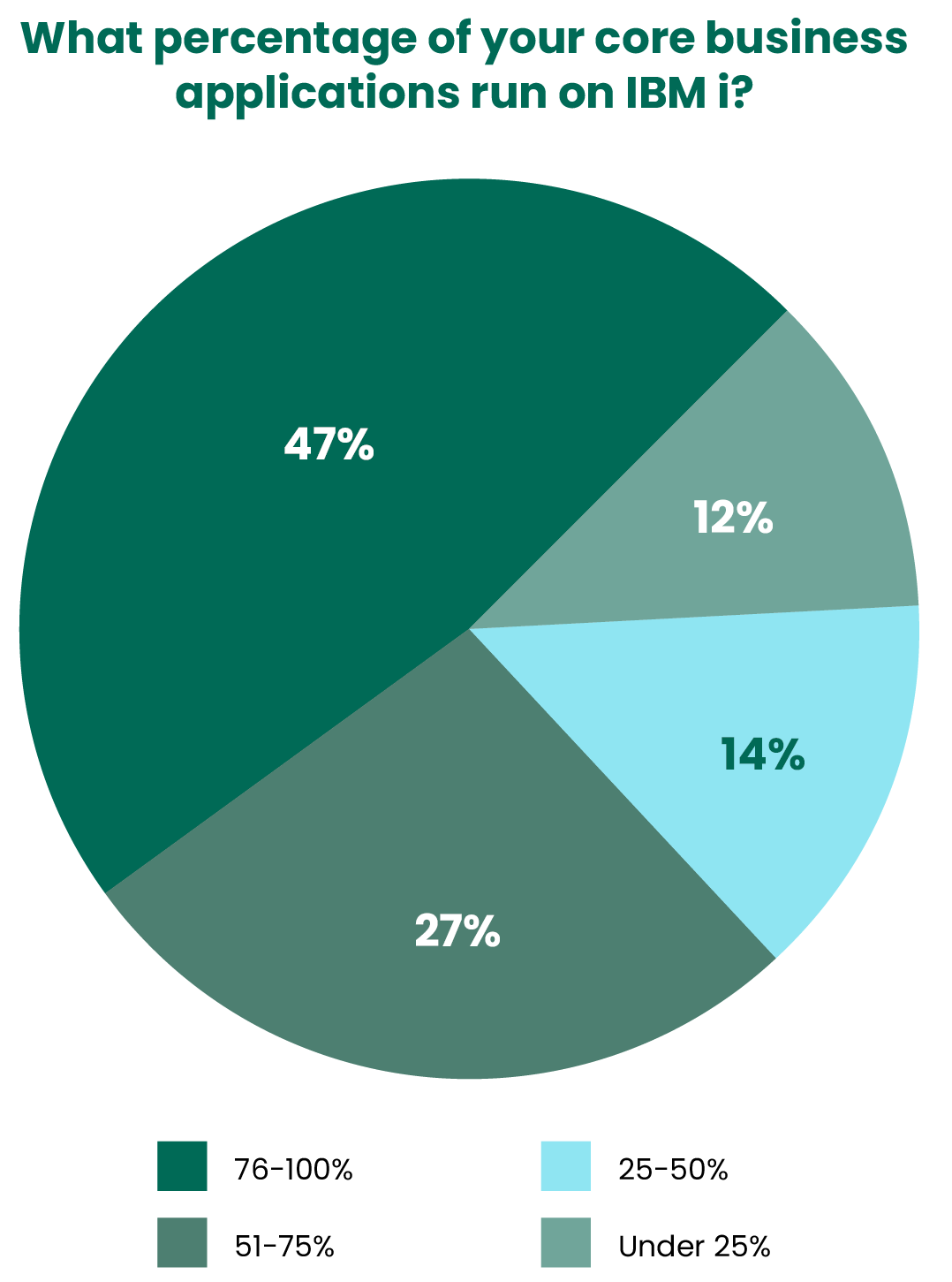
It’s no surprise that many businesses rely on IBM i for their most critical applications, given the platform’s reputation for dependability and durability. Since 2016, respondents running between 51% and 100% of their core business applications on IBM i has remained stable at around 70%. This demonstrates users’ confidence in the IBM i platform.
This year’s results are similar to last year’s: Just under half of survey respondents run more than 75% of their core business applications on IBM i. These results have remained steady over the years, with roughly three quarters of clients running half or more of their core applications on IBM i, and around 12% running 25% or less. For these customers, this typically means there’s a significant workload they’re running on IBM i – even though they have another system. This speaks to the reliability of IBM i, as these workloads are likely critical to their business, yet they’re finding no value in moving them off because they’re having success with the platform.
RECOMMENDATION:
With applications relying very much on access to core business data, the role of business intelligence (BI) cannot be underestimated when it comes to successful applications. Fortra has a suite of BI solutions and services that dovetail seamlessly with IBM i and allow business users and leadership teams to make smarter and more informed decisions based on real-time data. It should also be noted that IBM has a group called the ISV Council where early information on IBM i is released. You should let your application vendors know that this group exists and that they would benefit from reaching out to IBM to be a part of it.
Plans for the Platform
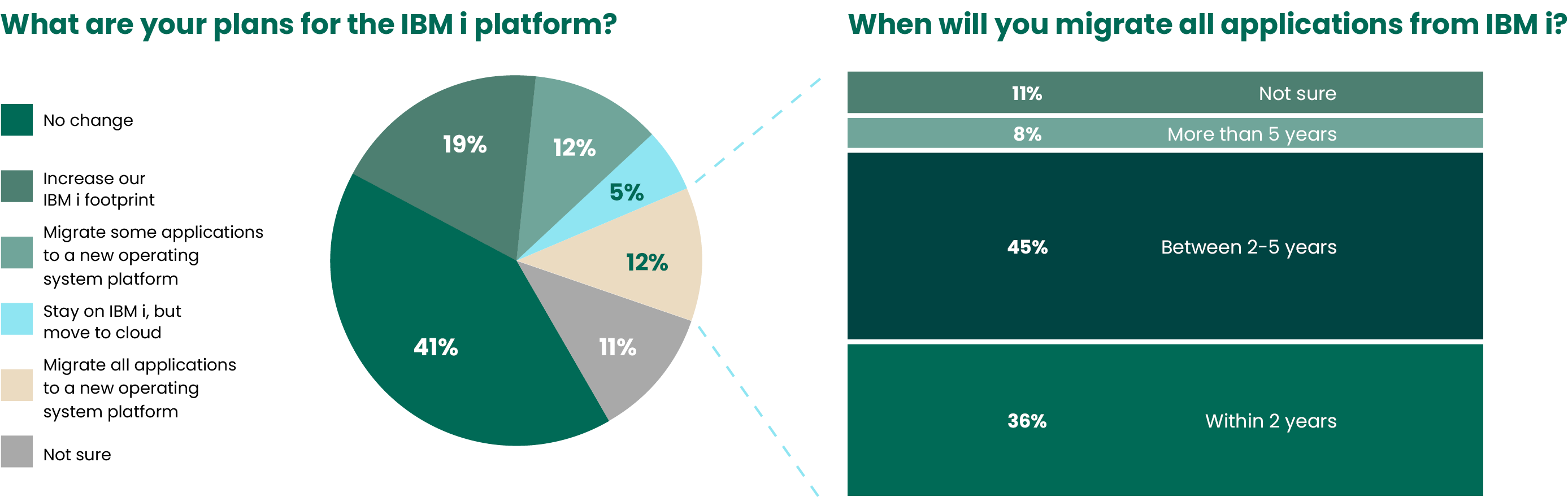
We have seen the value that users get from IBM i throughout the 12 years that we have been conducting the IBM i Marketplace Survey. For proof, look to the percentage of people planning to increase their IBM i footprint – a figure that stays around 20% year after year. This can largely be attributed to the fact that, from a management standpoint, IBM i requires fewer personnel and has a lower cost of ownership than other operating systems.
The percentage of businesses who will continue to use IBM i with no change in 2026 is slightly less than it was in 2025 (41% vs 45%). Additionally, the trend of customers moving to the cloud has slowed, with 5% of respondents reporting they will stay on IBM i but are moving to the cloud, compared to 10% in 2025.
Overall, there was a small uptick in customers looking to move some or all applications to a new operating system, with that number jumping from 18% to 24%. Concern regarding IBM i skills is likely a large contributor to this trend. In terms of where respondents are looking to move applications to, Windows and Linux-based servers come out highest at 37% each. If planning to move applications, Windows is not a surprising choice, as many organizations have Windows servers running alongside IBM i.
There isn’t much of an exodus from IBM i, as roughly 4% of respondents plan to migrate all applications from IBM i within 2 years. Of those planning to migrate their applications from IBM i, 64% don't have a plan to do so within 2 years. These customers typically end up sticking with the with the platform, as IT management often underestimates the time to switch and the long-term value of applications on IBM i.
RECOMMENDATION:
If you are thinking about leaving IBM i, you need to understand the true cost of migration. We have seen first-hand customers attempting to move off IBM i over a period of time and then failing to do so. This failure is very expensive to your organization as it sets you years behind in application modernization and hardware levels. Our recommendation is to talk to consultants who are for moving IBM i customers off IBM i as well as those who understand the value of IBM i and are against the move. They will help you understand the true costs associated with replatforming.
Return on Investment
The most constant result of the annual IBM i Marketplace Survey over the past 12years has been the value that IBM i provides to its consumers. IBM i has consistently delivered a high return on investment (ROI), and 2026 is no exception.
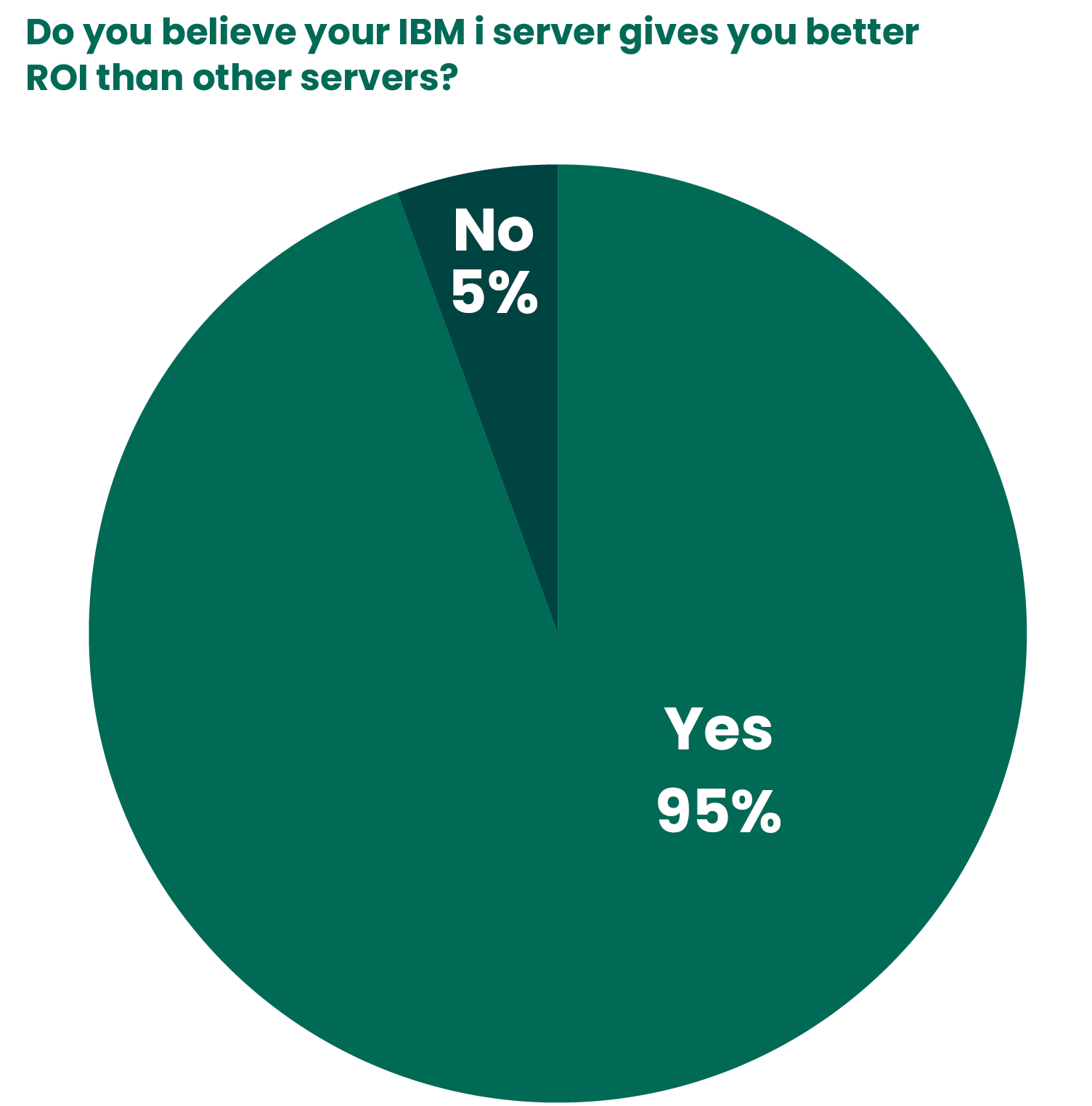
This year, 95% of respondents said they believe IBM i provided better ROI than other servers – almost the same as the record-high level of 96% last year.
This number has never been below 90% in a decade of analysis, demonstrating that IBM is committed to maintaining a system that provides substantial value to its devoted clientele.
We like to think of IBM i as one of the IT industry’s best kept secrets. The satisfaction and the continuity it provides means it’s rarely talked about during weekly meetings, making it easy for IT departments to forget that this platform is quietly upholding their business.
We know that many survey participants use multiple servers, so their opinions on the best server are well-informed. IBM i is a trusted platform, and its popularity will continue to rise in the years to come. The Global ITIC Reliability report from 2024 provides data on the reliability IBM Power servers, citing an astounding 99.9999999% uptime and reliability among z16 servers. This level of reliability coupled with financial feasibility delivers IBM i users a winning combination.