Report Table of Contents:
1. Introduction & Survey Highlights
2. IBM i in the Data Center (current page)
Trends for the Year
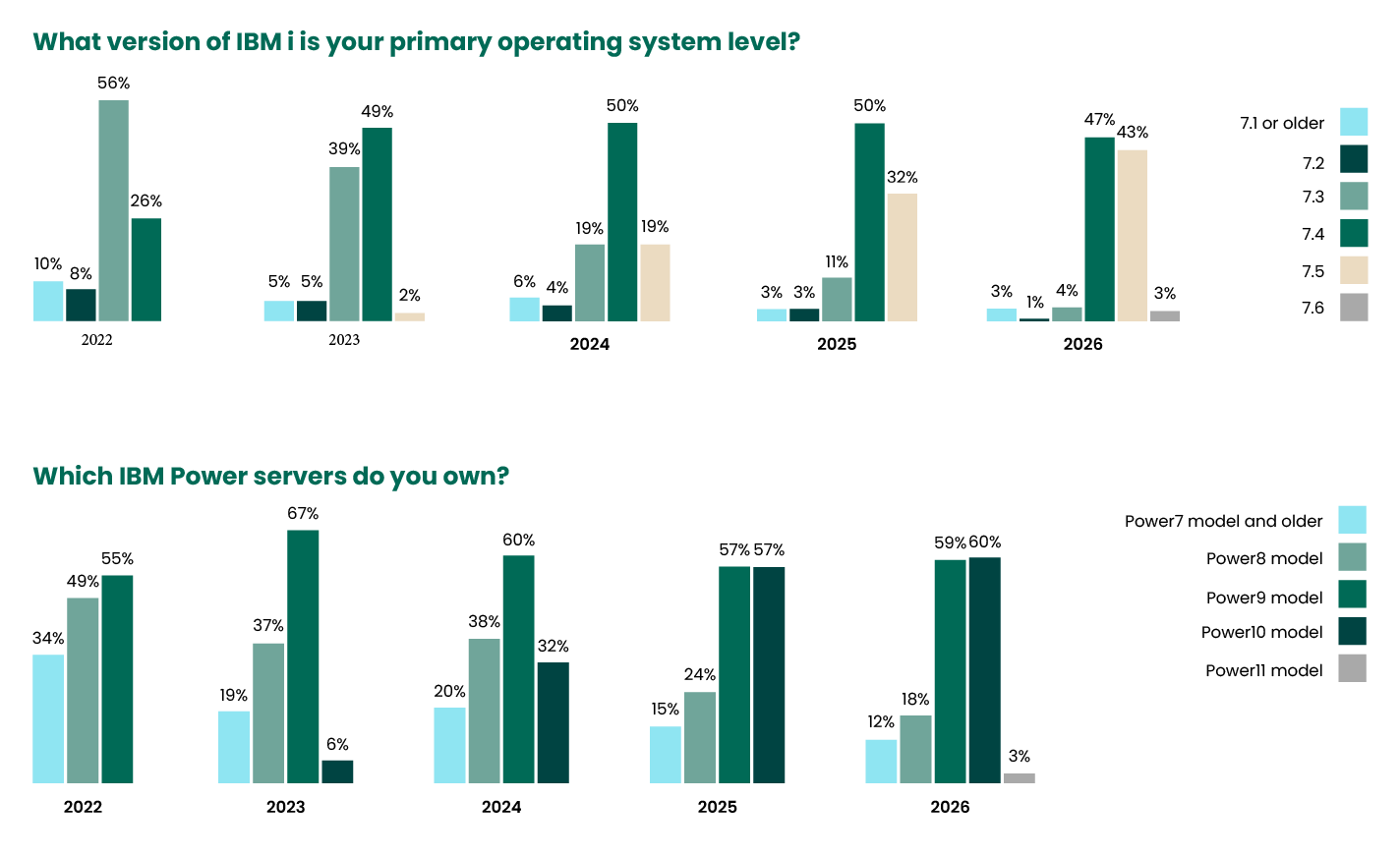
IBM i 7.6 was released in April, and 3% of respondents have already adopted it. IBM i 7.5 adoption has also continued to grow. At the same time, the use of older versions is steadily decreasing. Regarding Power servers, the latest version – Power11 – was introduced in March and is also being used by 3% of respondents, while Power10 adoption continues to grow – increasing from 57% to 60%.
With both releases only being on the market for such a short amount of time, it is difficult to say what the adoption rate of these new technologies will look like in the coming years. However, we expect IBM i 7.6 and Power11 adoption to meet or exceed past rates.
It is important to note that IBM i 7.4 has two key end-of-support dates nearing. The end of marketing (EOM) date is set for April 30, 2026, meaning new licenses will no longer be available. The Change of Service (COS) date is September 30, 2026, meaning standard support will end and transition to more expensive extended support. IBM Power9 standard support ends January 31, 2026, meaning no more new fixes, updates, or preventive maintenance from IBM. This should prompt a move to Power10 or Power11, though third-party support remains an option.
Upgrades
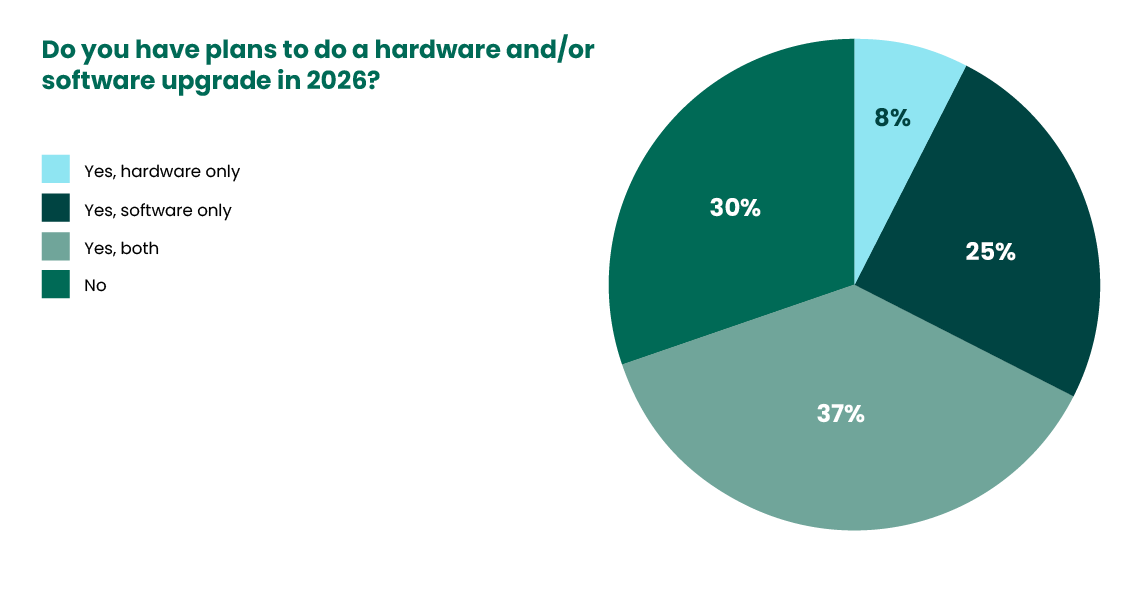
IBM i is an environment that provides great value to its users, and one to which users show loyalty and commitment. This is reflected in this year’s upgrade trends, with 70% of respondents planning to upgrade hardware, software, or both in 2026. This is significantly higher than last year’s figure, suggesting that customers are looking to capitalize on improved security in 7.6 – specifically MFA, which can only run on Power10 and Power11. It’s also possible that management teams have learned the importance of staying current on both hardware and software as it relates to overall security best practices.
Most customers who plan to upgrade both hardware and software prefer to tackle both projects simultaneously. 10% of respondents plan to stay on IBM i but move to the cloud, which can serve as another means of upgrading hardware and software.
30% of respondents have no plans for hardware or software upgrades in 2026. Most clients are on a 3-5 year refresh cycle, with hardware or software upgrades being performed individually by 32% of respondents.
This year, 60% of respondents are on Power10, and 3% have already migrated to Power11. This is no surprise, as we know customers desire the many benefits of new hardware relating to security, virtualization, high availability, and more.
IBM released Power Enterprise Pools 2.0 with Utility Capacity, which makes use of the IBM Cloud to simplify pool administration and automation of utility capacity management, so that private cloud infrastructures have more flexibility. IBM also announced subscription pricing on all Power9 and Power10 servers, as well as IBM i 7.3, 7.4, and 7.5. This mirrors the cloud pricing structure by giving customers the freedom to choose between categorizing IBM i investments as a capital expense or operating expense. To learn more about your IBM i billing options, read this overview from IT Jungle.
RECOMMENDATION:
For anyone that does upgrade their hardware in 2026, programs such as the IBM i Solution Edition, IBM Power VS, and Capacity Backup (CBU) boxes for high availability can be a huge help, with users eligible for rebates when new hardware and software are bundled together.
Power Server Capacity
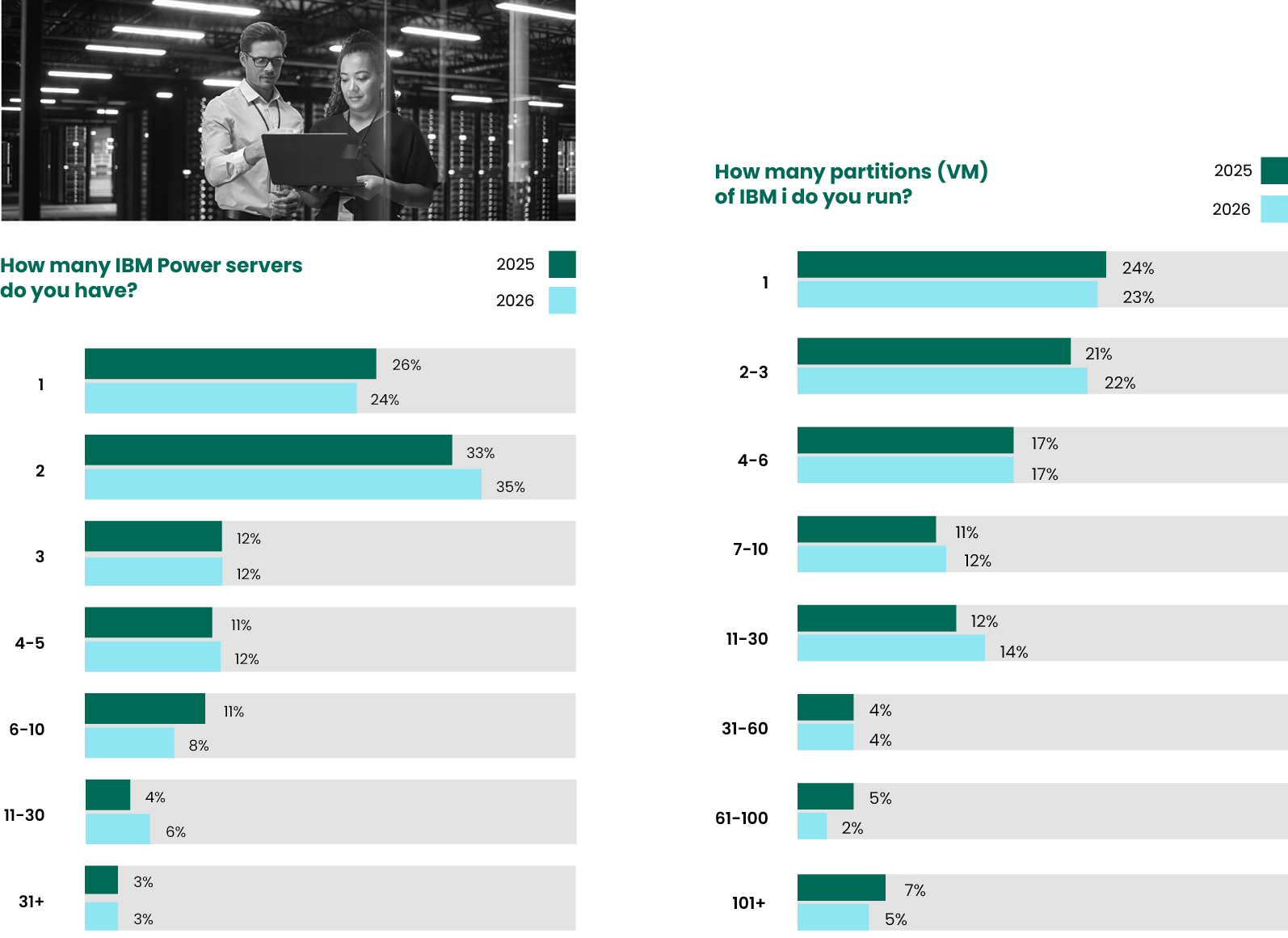
When it comes to the total number of IBM Power servers organizations use, the IBM i Marketplace Survey shows impressively stable patterns year after year, and this year is no different. Customers with two or more IBM Power servers are generally running some form of hardware- or software-based high availability, replication, or disaster recovery.
Turning attention to the number of partitions (virtual machine technology) respondents are running, there has been a steady trend over the years of businesses consolidating servers but increasing the number of partitions they’re running. This year, 22% of respondents are running 2-3 partitions, while those running 11-30 partitions grew slightly. These are figures that we expect to remain fairly stable over the coming years, as nearly 80% of the market already has some form of partition on IBM i.
More than one-third of respondents run between two and six partitions. These VMs can share storage, processor and memory, and even support live partition mobility (LPM).
We expect the use of virtual machine technology to continue growing over time. This allows customers to run separate environments for development, quality assurance, high availability, Linux, and AIX alongside their IBM i production environment all in one physical IBM Power server. It also enables reduced power consumption and more effective utilization of resources.
Year after year, we see a consistent and relatively even distribution among the answer choices for how many servers and partitions respondents rely on. This points to the healthy diversity among the types of organizations that use this software and hardware combination.
Other Operating Systems
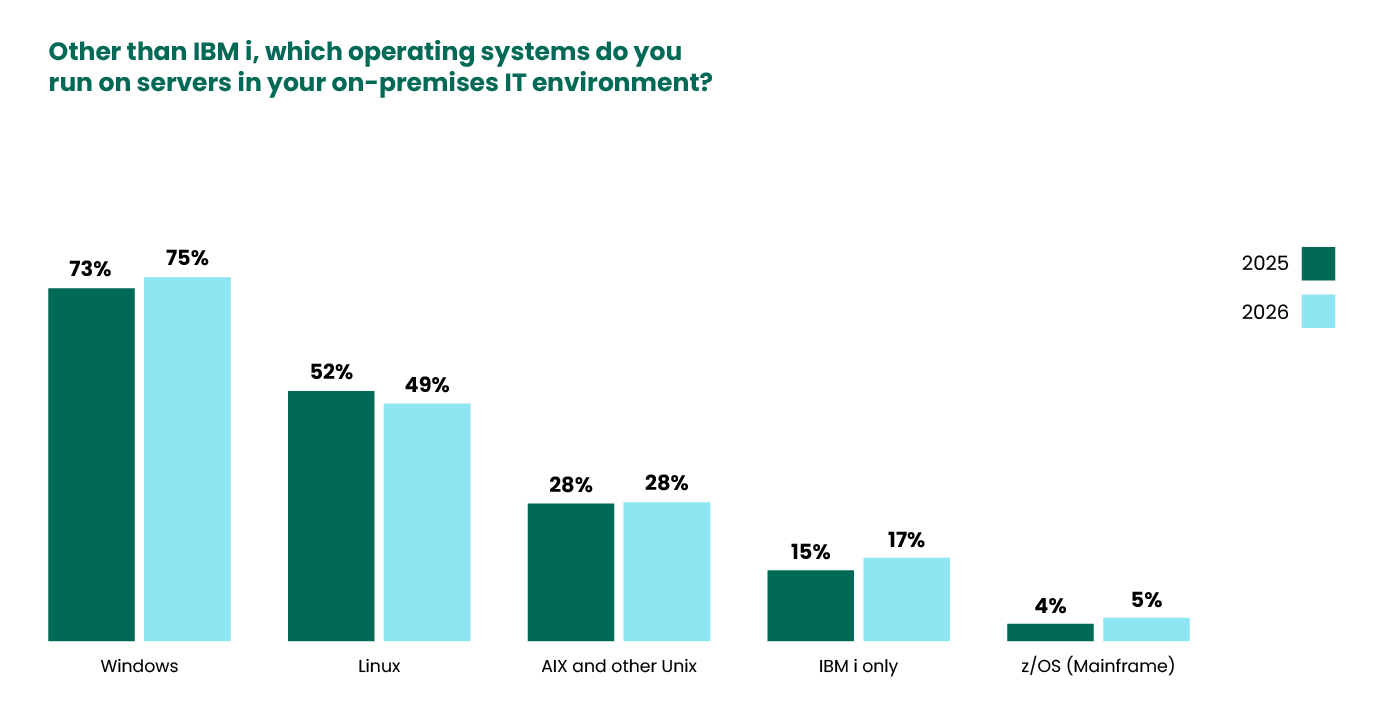
Most companies using IBM i also run additional operating systems beside it. Windows leads, as it has in every previous year. Linux is competitive, with 49% of survey respondents using this operating system.
A growing segment of customers rely solely on IBM i to run their business, with IBM i-only responses increasing from 15% to 17%. Another 28% of businesses leverage AIX and other Unix-based systems for their on-premises IT environment.
It’s interesting that Linux growth hasn’t cut into Windows usage. This suggests that organizations could be shifting to using three operating systems in their environment. Perhaps when new Linux workloads are added to their environment, the Windows servers are sticking around to assist with modernizing workloads. Instead of replacing and moving the workloads to other platforms, IT teams seem to be standing up different servers alongside Windows to eliminate the effort of moving servers where things are working properly. We often see IBM i serving as the centralized database server with other non-IBM i applications depending on this data via API calls for web applications, data marts, and other business intelligence technologies.
Infrastructure Location
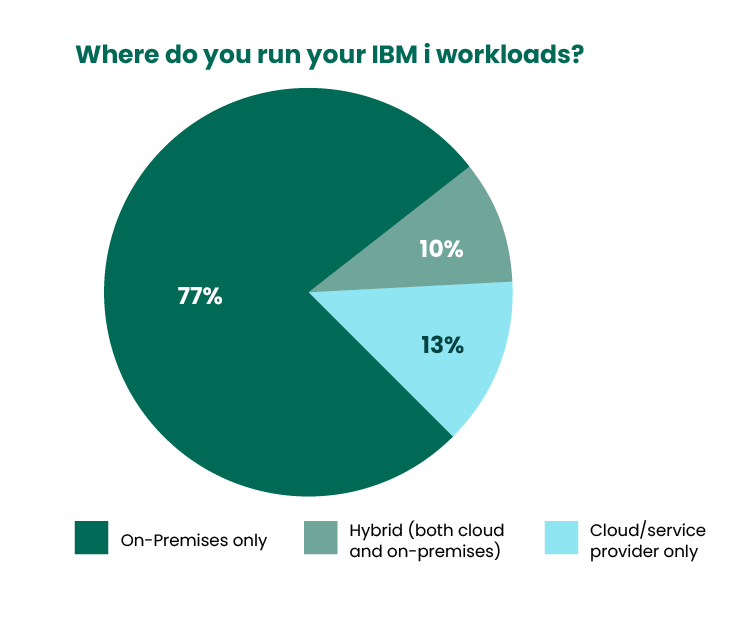
Typically, IBM i users run most of their workloads on-premises. That’s certainly true this year, with 77% of organizations planning to run their IBM i workloads onpremises only. At the same time, interest in IBM i in the cloud remains somewhat steady. However, this year, the number of respondents electing to use only a cloud/service provider reached a record-high 13%, overtaking the use of hybrid environments.
This is a figure that we expect to continue to climb. The significant number of IBM i customers in the cloud and growing proportion of those relying on service providers go hand-in-hand with the continued need for modernized applications and the concern over IBM i skills. Organizations are using cloud providers to offload some of the responsibilities associated with owning and operating IBM i – such as PTF work or hardware maintenance. Others use the cloud as a means of eliminating some financial elements of owning IBM i, such as paying for future upgrades or the long-term costs of owning and operating a data center.
It is also important to note that cloud usage may be underreported, as it is common for IBM i shops to run their HA/DR in the cloud and may not consider this as qualifying as a hybrid environment.
RECOMMENDATION:
Running IBM i workloads in the cloud has great benefits. If your organization is considering moving to the cloud, check out our guide on items to consider before making the move. To learn more about best practices for migrating and maintaining workloads in the cloud, watch this webinar to get expert advice.
Staffing
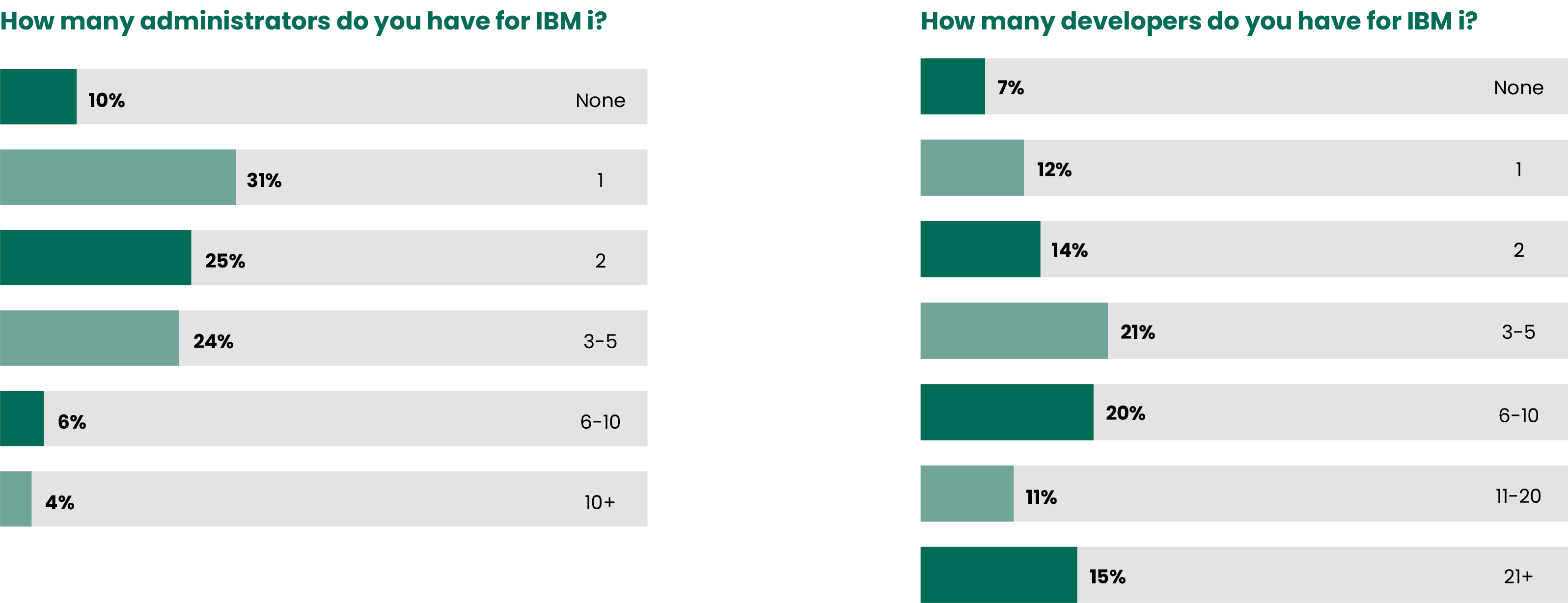
A considerable proportion of businesses (21%) continue to report employing 3-5 IBM i developers, a figure that has remained fairly stable the past 10 years. This consistency in developer numbers corresponds to the variety of languages, open source, and tools like RDi and VS Code that are used to continue furthering the core IBM i applications. It demonstrates a large commitment to modernizing the applications that serve many industries.
Applications written or highly modified in-house – which often constitute a large percentage of organizational applications – require ongoing modernization RECOMMENDATION: Having the right expertise is a key component of any successful IBM i environment. If you feel your team is under-resourced or lacking certain skills, check out our training options to fill any gaps you may have. IBM i user groups like COMMON USA and Common Europe also offer educational and networking opportunities. If you are a member of COMMON, you also have access to free security and administration boot camps. efforts. This means companies must keep a team that continuously optimizes for everchanging business needs.
A key unique selling proposition of IBM i is its need for little day-to-day administration. This year, 66% of our respondents have fewer than three administrators in total for IBM i, while 10% of respondents selected the “none” option – both of which are higher than in 2025. This could signify their use of managed services or artificial intelligence to monitor their systems and keep their OS up to date.
RECOMMENDATION:
Having the right expertise is a key component of any successful IBM i environment. If you feel your team is under-resourced or lacking certain skills, check out our training options to fill any gaps you may have. IBM i user groups like COMMON USA and Common Europe also offer educational and networking opportunities. If you are a member of COMMON, you also have access to free security and administration boot camps.
Business Applications
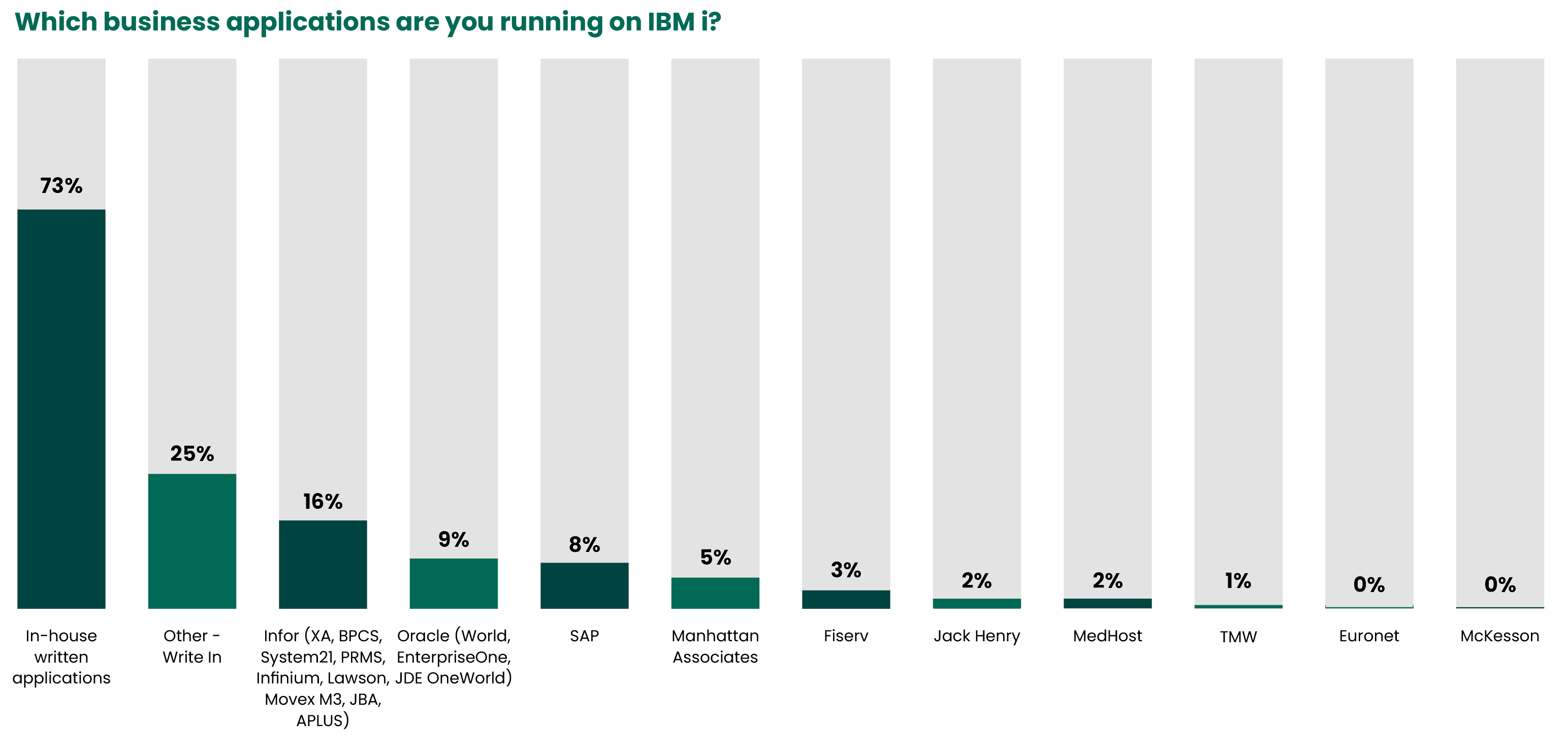
Homegrown applications that are written in-house remain the most commonly run applications on IBM i at 73%. Other “Write In” applications, tailored to specific business cases like medical, finance, warehousing, manufacturing, and public administration, continue to account for more than a quarter of business applications running on IBM i. In addition, Oracle and/or Infor are used by 25% of survey respondents. Infor remained stable, and Oracle JDE Edwards World and EnterpriseOne customers continue to stick with IBM i despite efforts to move them to other Oracle applications.
IBM i is a highly flexible and versatile platform, as indicated by the volume of different business applications noted. This also points to the continued importance of modernization and the vastness of the demographics on display in this survey. Nearly Which business applications are you running on IBM i? three quarters of respondents use applications written in-house even if they’re also using external solutions, suggesting a plethora of unique industries where IBM i has a presence and a diversity among the roles IBM i plays.
With flexibility so highly valued in business, this trend of application diversity is likely to continue. These unique business applications will continue to make IBM i a sticky platform. Note, however, that when writing applications in-house, it is essential to adhere to application modernization and security principles, and to make sure your developers are educated and trained on writing secure and quality applications.
IBM’s efforts to help customers generate code with AI may accommodate organizations with a lack of staff and skills in these areas. This year, they are launching Bob, an AI software development partner designed to help teams ship quality code faster and catch issues before they ever reach a pull request.